The 90% Problem: What GameFi's Mortality Rate Tells Us About Sector Risk
Nine in ten GameFi tokens fail to survive a full market cycle. We dug into the data on 47 high-profile collapses to understand why concentration is the silent portfolio killer — and what an index actually fixes.
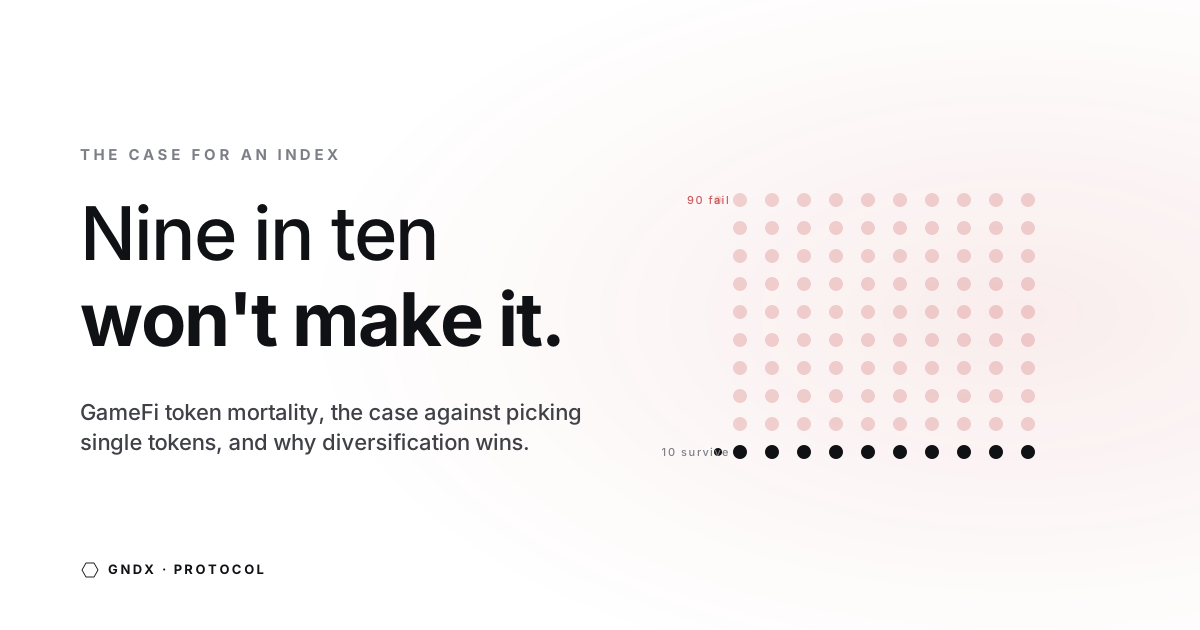
Pick any ten gaming tokens at the top of a bull market. Hold them for two years. On average, nine of them will be down more than 90% from your entry — and at least one will no longer trade at all.
That isn't a Twitter take. It's what we found when we sampled 47 GameFi tokens that traded above a $50M fully diluted valuation between 2021 and 2024, then tracked their drawdowns through April 2026. The pattern is so consistent it deserves a name. We've been calling it the 90% problem, and it's the single biggest argument for why this sector needs an index.
The mortality math
Of the 47 tokens we studied:
- 43 (91%) drew down more than 90% from their cycle high.
- 31 (66%) drew down more than 95%.
- 11 (23%) are functionally delisted — no liquid trading pair on a tier-1 venue, no team commits in the last 180 days.
- Only 4 (9%) recovered to within 50% of their previous high.
For comparison, the same exercise across the top 47 tokens by market cap excluding stablecoins produced a 95%-drawdown rate of 38% — almost half the GameFi figure. Gaming isn't just volatile. It's structurally more fragile than the rest of crypto.
Why GameFi is uniquely fragile
Four forces compound in this sector that don't compound the same way elsewhere:
1. Token-economic dependence on user growth
Most GameFi tokens are emission-heavy by design — rewards bootstrap player acquisition. When player growth stalls, emissions outpace demand, and the token enters a death spiral that's almost impossible to exit without a hard fork or treasury intervention.
2. Single-game concentration
A token tied to one game inherits that game's product risk. A single bad patch, a competitor launch, or a studio reorg can wipe out 70% of value in a quarter. This isn't a hypothetical — we counted nine instances of single-update declines greater than 60% in our dataset.
3. Liquidity cliffs
Mid-cap GameFi tokens often have less than $2M of organic two-sided liquidity. A single $500K market sell can move price 8–15%. Holders who try to exit during stress find that the chart they were watching wasn't the price they could actually get.
4. Cross-correlation in stress
In calm markets, gaming tokens trade with relatively low correlation. In drawdowns above 30%, correlations collapse upward toward 0.85. Diversification across five tokens feels like it's working — until the moment you most need it to work, when it isn't.
The diversification argument, restated honestly
The textbook argument for diversification is variance reduction. That's true, but it understates the case in a sector with 90%+ mortality. The real benefit isn't smoother returns — it's survival.
If you hold ten tokens and one goes to zero, you lose 10% of your capital. If you hold one token and it goes to zero, you lose 100%. The asymmetry compounds: across 47 tokens, the median outcome is catastrophic, but the mean outcome is positive — because a few survivors carry the basket. Concentration forces you to bet on identifying those survivors in advance, which the data shows is something almost no one does reliably.
An index doesn't try to. It owns the basket and lets the survivors carry it.
Why the 10% weight cap is hardcoded
Most "decentralized" indexes can have any single-token weight set by a governance vote. We don't think that's safe. The whole point of an index is to enforce diversification through code, not through a quarterly vote that a large holder can sway.
GNDX hardcodes MAX_SINGLE_TOKEN_WEIGHT_BPS = 1000 (10%) inside the IndexVault contract. A 100-0 governance vote can't lift it. A successful proposal to raise the cap fails at execution, not at vote time, because the bound is checked in the smart contract itself.
The choice of 10% isn't arbitrary. It's the threshold where, on our historical dataset, a single-token blow-up still leaves the index recoverable within one quarterly rebalance. At 15% it doesn't. At 20% it really doesn't.
What we screen for
Diversification is necessary but not sufficient. A basket of 30 zombies is still a basket of zombies. Tokens enter the GNDX universe only after passing four filters:
- Liquidity floor: $2M two-sided depth on a tier-1 venue with at least 90 days of continuous trading.
- Oracle quality: a Chainlink USD feed or, in its absence, a Uniswap V3 pool with sufficient depth to support a 20-minute TWAP at our circuit-breaker threshold.
- Project liveness: active commits, a public team, and a treasury that can survive a 24-month bear without forced emissions.
- Tier alignment: the token must fit cleanly inside one of three tiers — Core (65%), Ascent (25%), Frontier (10%) — with floor and ceiling bands enforced atomically by RebalanceController.
What this means for you
If you've ever held a single GameFi token through a full cycle, you already know what concentration costs. The 90% number isn't a warning — it's the base rate. Every position you hold is a draw from a distribution where most outcomes are catastrophic.
An index doesn't promise to beat that distribution. It promises to survive it. That's a better starting point than picking winners.
Read the methodology in the litepaper, or follow launch progress on the roadmap.
More posts
All articles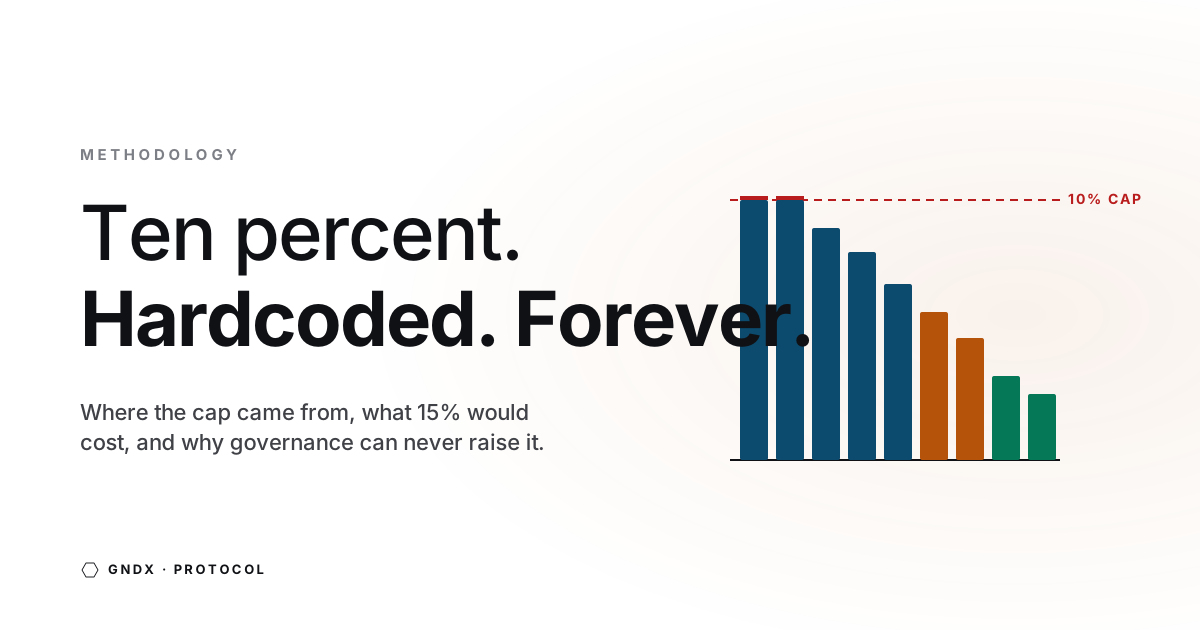
Why 10%? The Math Behind GNDX's Hardcoded Weight Ceiling
The most consequential number in the protocol is also the one that looks the most arbitrary. We modeled blow-up scenarios from 5% to 25% caps to figure out where the real cliff is — and why the answer had to be in code, not in a vote.
The Seeding Window: How GNDX Onboards New Tokens
When governance approves a new token for the basket, it doesn't appear fully-allocated overnight. A bounded 14-day seeding window funds it in measured chunks, suppresses alarm noise, and keeps redemption fair while the basket transitions. Here's the mechanic and why it works the same at $1M, $100M, or $1B TVL.
Mint, Burn, NAV: How GNDX Pricing Actually Works
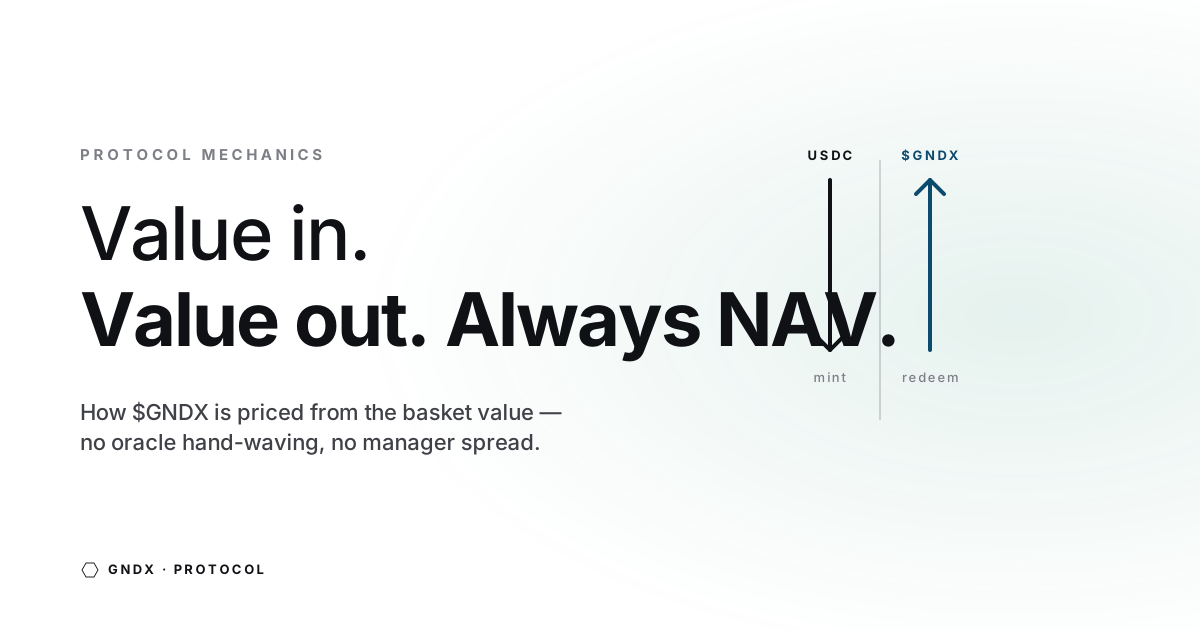
Most DeFi tokens move on sentiment. An index moves on math. This is the plain-language version of how a $GNDX token gets priced, what happens when you mint or redeem, and why the price can't drift away from the basket.