How veGAME Works: A Plain-Language Guide to Vote-Escrowed Governance
veGAME is the part of the protocol that decides what GNDX owns and how it earns. If you're holding $GAME and wondering what to actually do with it — or what 'vote-escrowed' even means — start here.
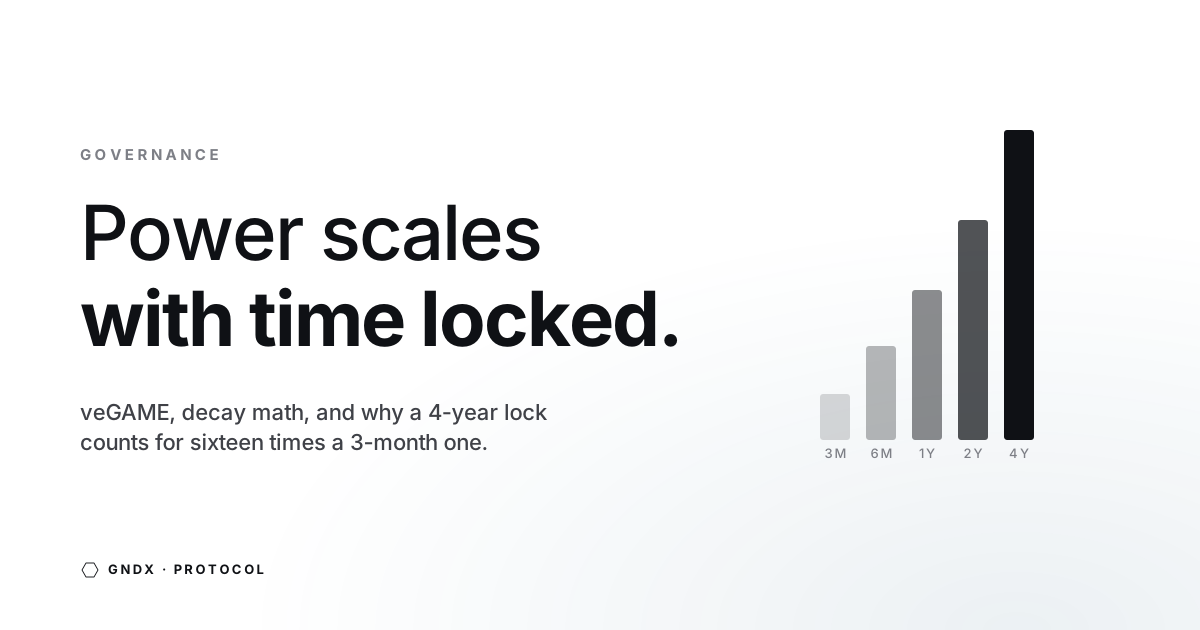
If you've spent any time in DeFi you've seen the prefix ve — veCRV, veBAL, veGAME. It stands for vote-escrowed, which is jargon for a very simple idea: the longer you're willing to lock your tokens, the more say you get.
This guide explains exactly what that looks like for $GAME holders. No code, no equations you need a whiteboard for — just the model, a worked example, and answers to the questions we get most often.
The two-token model, in one paragraph
GNDX has two tokens because it does two things. $GNDX is the index product — you mint it with USDC, it tracks a basket of gaming tokens, you redeem it for the basket or back to USDC. $GAME is the governance token — you lock it as veGAME to vote on what's in the basket, what the fees should be, and how the protocol's revenue is used. They never get confused: $GNDX moves with NAV, $GAME moves with governance attention.
What "vote-escrowed" actually means
When you lock $GAME, three things happen at the same time:
- You pick a lock duration: 3 months, 6 months, 1 year, 2 years, or 4 years. Those are the only five choices.
- The protocol mints you a non-transferable veGAME balance. The longer you locked, the bigger that balance.
- Your veGAME balance decays linearly to zero as your lock unwinds. It is at its peak the moment you lock, and exactly zero the moment you can withdraw your $GAME.
The decay is the whole mechanism. It means voting power is something you have to keep refreshing — by extending your lock or topping it up — if you want to keep your influence. Holders who lock and forget gradually lose voice to holders who stay engaged. That's by design.
The five durations and what they're worth
Every lock has a multiplier that decides how much veGAME you get per $GAME locked at the start:
- 3 months — 0.25×. Lock 1,000 $GAME, start with 250 veGAME.
- 6 months — 0.50×. Lock 1,000 $GAME, start with 500 veGAME.
- 1 year — 1.00×. Lock 1,000 $GAME, start with 1,000 veGAME.
- 2 years — 2.00×. Lock 1,000 $GAME, start with 2,000 veGAME.
- 4 years — 4.00×. Lock 1,000 $GAME, start with 4,000 veGAME.
No other durations are valid — the contract reverts on anything else. The reason there are only five tiers is so the UI, the analytics, and your mental model all agree on what's possible.
Why the decay matters more than the multiplier
The multiplier is the sticker price. The decay is what you actually own over time. If you lock 1,000 $GAME for one year, you start with 1,000 veGAME, but six months in you only have 500. Three quarters in, 250. The day before unlock, almost zero.
This has two consequences worth internalizing:
- Long locks aren't a bigger gift, they're a longer commitment. A 4× multiplier on a 4-year lock isn't free leverage — it's the protocol paying you for committing to the project's outcome over a much longer horizon.
- Your effective average voting power is roughly half the peak. A 1,000 $GAME / 1-year lock gives you the area under a triangle: average ~500 veGAME across the year, not 1,000.
What you actually get for locking
Two things, neither of them speculative:
1. A share of protocol fee revenue
GNDX collects fees in three places: a small mint fee on USDC deposits, a redemption fee on exits, and a streaming fee on assets under management. Once a week, those fees get pooled, swapped through a single USDC leg, and converted into $GAME. A configured slice of that $GAME is deposited into the veGAME contract and distributed to lockers in proportion to their veGAME balance at the time of distribution.
That last part is important: the snapshot is your live, decayed balance — not what you started with. If you locked early but let your position decay, you'll get a smaller slice than someone who locked recently and is at their peak.
2. The right to vote on proposals
veGAME is the only thing that can submit and vote on a GNDX governance proposal. You need at least 1,000 veGAME to submit a proposal. Proposals require a 5% quorum of total veGAME supply and a 66% supermajority of FOR-vs-AGAINST votes to pass. Standard changes go through a 48-hour timelock; contract upgrades go through a 7-day timelock. There is no shortcut.
A worked example
Suppose you have 10,000 $GAME and you're trying to decide between three approaches.
- Plan A: 6-month lock. Start with 5,000 veGAME, decay to zero in six months. Average voting power: ~2,500 veGAME. Re-lock decision in six months.
- Plan B: 1-year lock. Start with 10,000 veGAME, decay to zero in twelve months. Average: ~5,000 veGAME.
- Plan C: 4-year lock. Start with 40,000 veGAME, decay to zero in four years. Average: ~20,000 veGAME.
Plan C gets you 4× the average voting power and 4× the average fee share of Plan B — but you can't touch the underlying $GAME for four years. There is no early exit, no penalty unwind. The trade-off is intentional and one-way.
Common questions
Can I add more $GAME to an existing lock?
Yes. The new $GAME inherits the existing unlock date and gets the same remaining-duration multiplier as your existing position.
Can I extend a lock?
Yes — you can extend to any duration that ends later than your current unlock. Your veGAME balance recomputes against the new duration.
Can I transfer veGAME?
No. veGAME is non-transferable by design. Lock-and-flip would defeat the whole mechanism.
What happens at unlock?
Your veGAME balance is zero, your fee share stops accruing, and you can withdraw your original $GAME. You then decide whether to re-lock.
What if I never claim my fees?
They sit in the contract waiting for you. There's no expiration. We'd still rather you claim — it makes the on-chain accounting cleaner — but you won't lose anything by being late.
The takeaway
veGAME is the protocol's way of asking: how much do you actually believe in this thing? Short locks say "I'm interested." Long locks say "I'm here." The protocol pays you proportionally for the stronger answer, and lets your voting power fade if the answer changes.
Once the protocol is live on mainnet, you'll be able to acquire $GAME and lock it as veGAME from the governance page. Until then, follow launch progress on the roadmap and join the conversation in Discord — we read everything.
More posts
All articles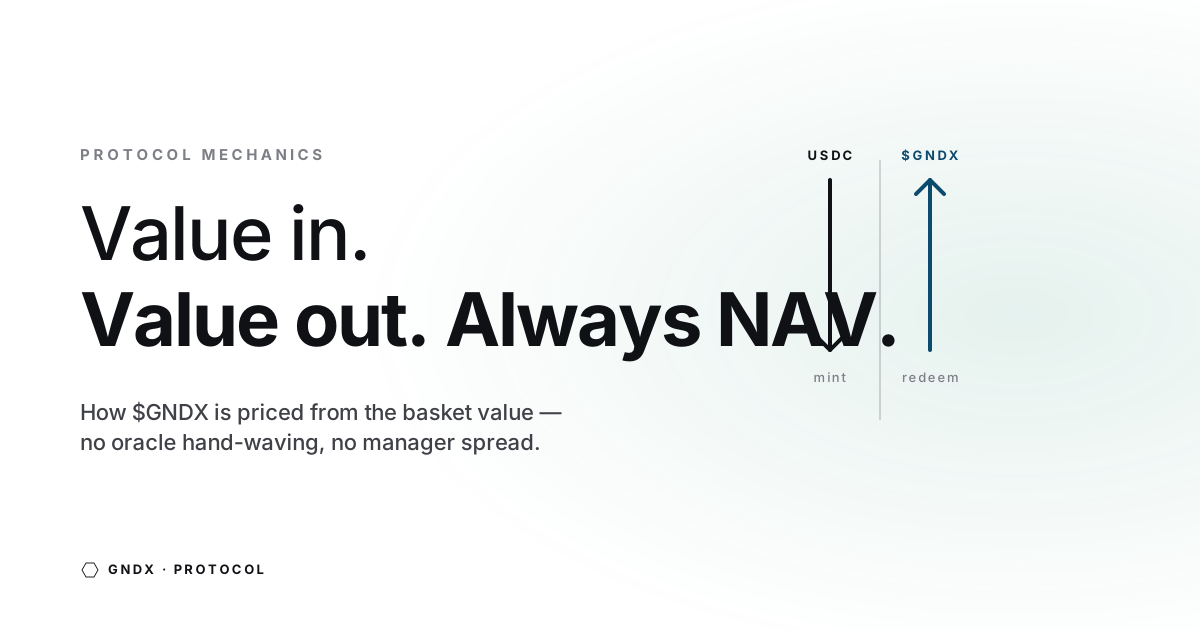
Mint, Burn, NAV: How GNDX Pricing Actually Works
Most DeFi tokens move on sentiment. An index moves on math. This is the plain-language version of how a $GNDX token gets priced, what happens when you mint or redeem, and why the price can't drift away from the basket.
The Seeding Window: How GNDX Onboards New Tokens
When governance approves a new token for the basket, it doesn't appear fully-allocated overnight. A bounded 14-day seeding window funds it in measured chunks, suppresses alarm noise, and keeps redemption fair while the basket transitions. Here's the mechanic and why it works the same at $1M, $100M, or $1B TVL.
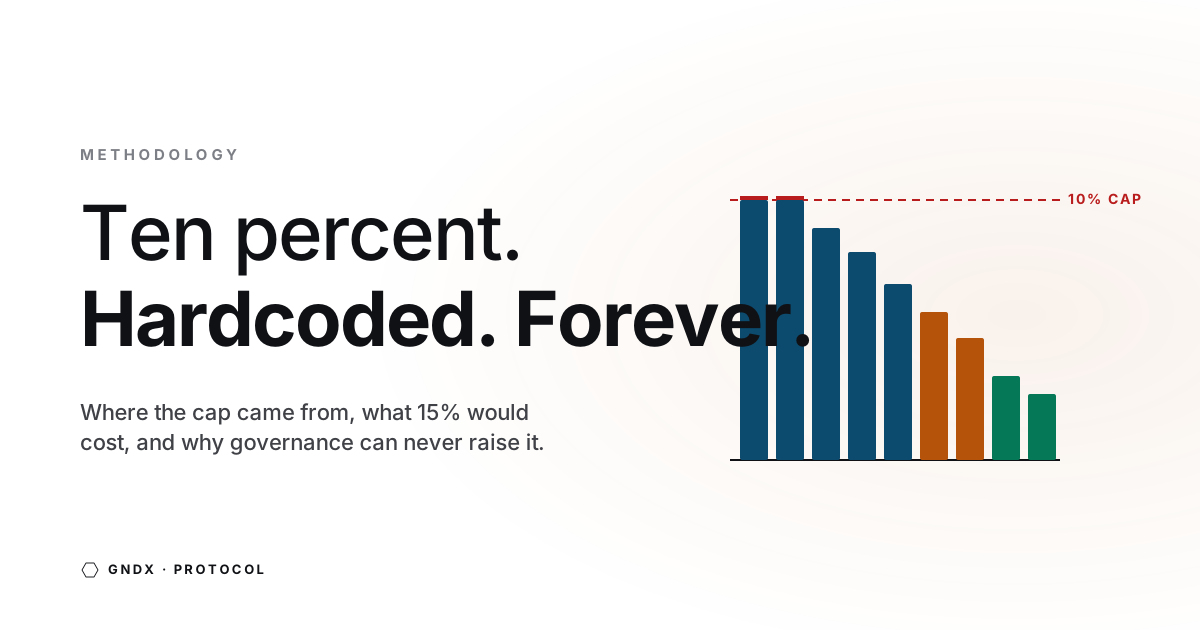
Why 10%? The Math Behind GNDX's Hardcoded Weight Ceiling
The most consequential number in the protocol is also the one that looks the most arbitrary. We modeled blow-up scenarios from 5% to 25% caps to figure out where the real cliff is — and why the answer had to be in code, not in a vote.